
4.5 KiB
🪁 Modular Monolith Architecture Style
In Modular Monolith Architecture, the application is divided into modules, each responsible for a specific functionality. However, the entire application is still deployed as a single unit.
Table of Contents
- Key Features
- When to Use
- Challenges
- Modular Monolith Architecture Design
- Development Setup
- How to Run
- Documentation Apis
Key Features
- Modular Design: The application is divided into modules, each responsible for a specific functionality.
- Loose Coupling: Modules interact through well-defined interfaces, improving maintainability.
- Single Deployment: The entire application is still deployed as one unit.
- Shared Database: Typically uses a single database, but modules can have their own schemas or tables.
When to Use
- Medium to Large Projects: Suitable for applications with growing complexity but not ready for microservices.
- Better Maintainability: Ideal for teams wanting a more organized and maintainable codebase than a traditional monolith.
- Future-Proofing: A stepping stone toward microservices, allowing teams to prepare for future scalability.
- Single Team or Small Teams: Works well for teams that want modularity without the overhead of distributed systems.
Challenges
- Still a single deployment unit, so scaling is limited.
- Requires careful design to avoid tight coupling between modules.
- Not as scalable or fault-tolerant as microservices.
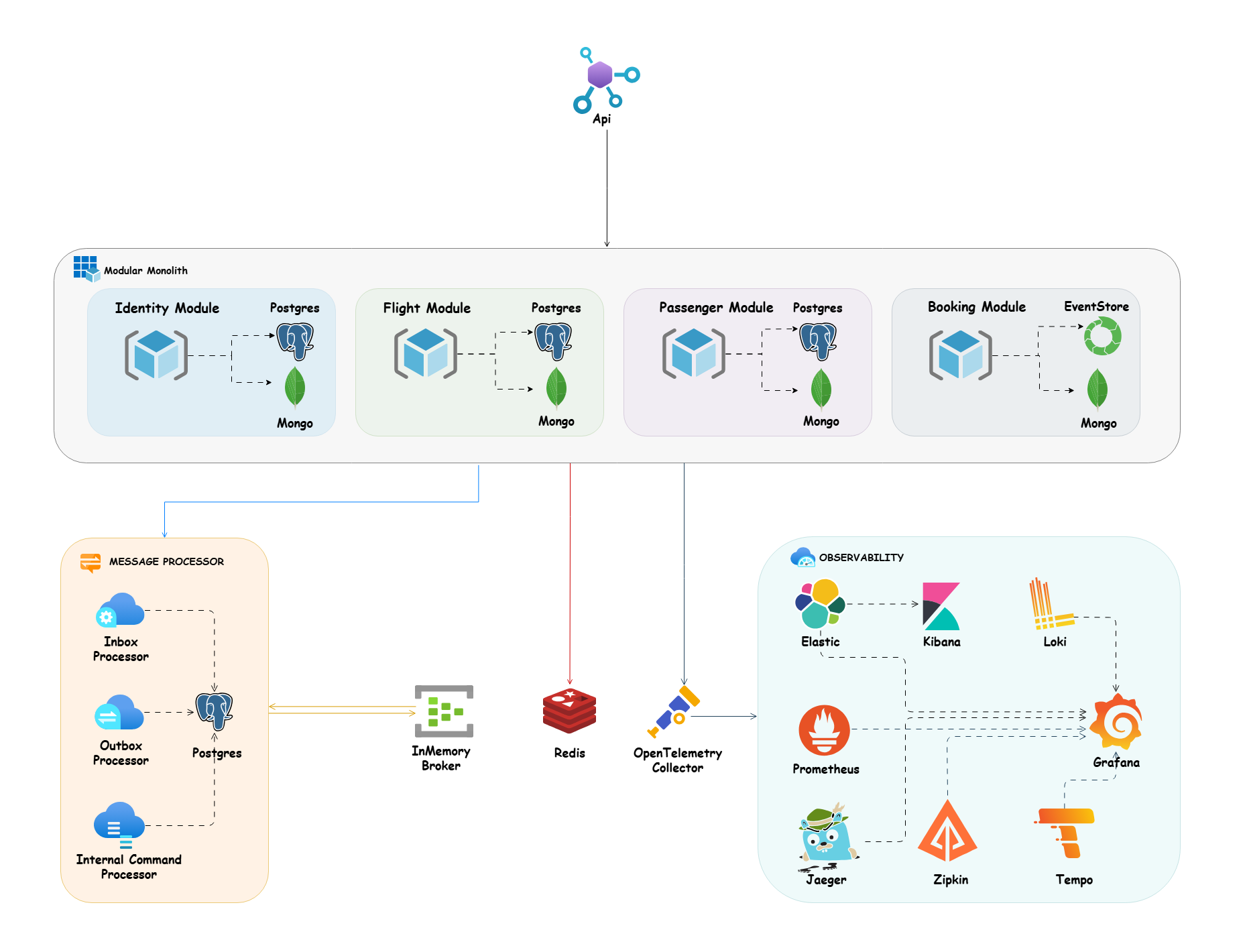
Modular Monolith Architecture Design
Development Setup
Dotnet Tools Packages
For installing our requirement packages with .NET cli tools, we need to install dotnet tool manifest.
dotnet new tool-manifest
And after that we can restore our dotnet tools packages with .NET cli tools from .config folder and dotnet-tools.json file.
dotnet tool restore
Husky
Here we use husky to handel some pre commit rules and we used conventional commits rules and formatting as pre commit rules, here in package.json. of course, we can add more rules for pre commit in future. (find more about husky in the documentation)
We need to install husky package for manage pre commits hooks and also I add two packages @commitlint/cli and @commitlint/config-conventional for handling conventional commits rules in package.json.
Run the command bellow in the root of project to install all npm dependencies related to husky:
npm install
Note: In the root of project we have
.huskyfolder and it hascommit-msgfile for handling conventional commits rules with provide user friendly message andpre-commitfile that we can run ourscriptsas apre-commithooks. that here we callformatscript from package.json for formatting purpose.
Upgrade Nuget Packages
For upgrading our nuget packages to last version, we use the great package dotnet-outdated. Run the command below in the root of project to upgrade all of packages to last version:
dotnet outdated -u
How to Run
Docker Compose
To run this app in Docker, use the docker-compose.yaml and execute the below command at the root of the application:
docker-compose -f ./deployments/docker-compose/docker-compose.yaml up -d
Build
To build all modules, run this command in the root of the project:
dotnet build
Run
To run all modules, run this command in the root of the Api folder where the csproj file is located:
dotnet run
Test
To test all modules, run this command in the root of the project:
dotnet test
Documentation Apis
Each microservice provides API documentation and navigate to /swagger for Swagger OpenAPI or /scalar/v1 for Scalar OpenAPI to visit list of endpoints.
As part of API testing, I created the booking.rest file which can be run with the REST Client VSCode plugin.